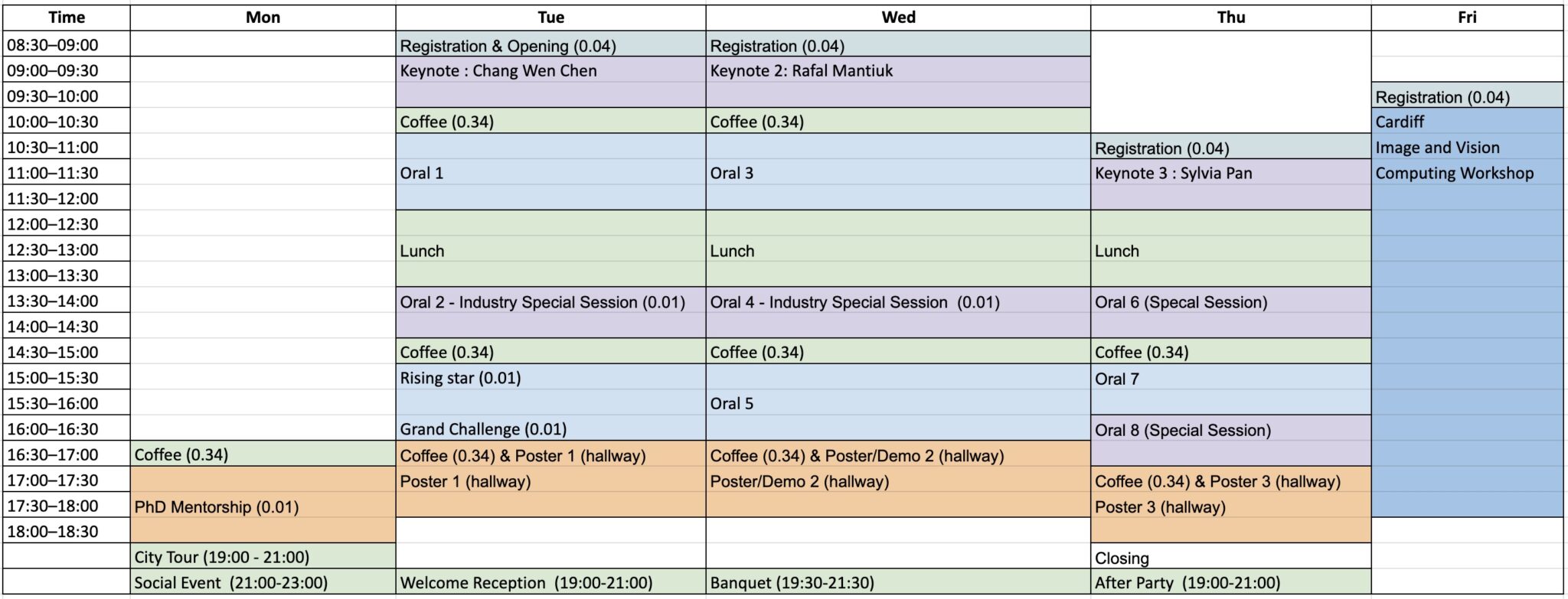
Program

Cardiff, UK, June 29th - July 3rd, 2026

QoMEX 2026 - Quality of Multimedia Experience Meets Machine Intelligence

Tuesday, June 30

Keynote 1: Chang Wen Chen
🎤 Session Chair: Wei Zhou

From Perception to Principles: Quality Assessment for AI-Generated Visual Contents

The rapid advancement of generative AI (GenAI) has transformed the creation of images and videos, enabling unprecedented levels of visual realism, diversity, and controllability. Yet one pressing issue is in how to properly assess the quality of AI-generated visual content as such new types of contents poses significant challenges that extend well beyond the scope of traditional image and video quality assessment. Whereas conventional approaches have largely focused on perceptual distortions such as blur, noise, compression artifacts, and transmission degradation, assessing generated contents calls for a broader spectrum of evaluation framework one that have to consider semantic fidelity, temporal coherence, physical plausibility, aesthetic quality, and exact alignment with human expectations and prompts. This keynote will examine the transition from traditional perception-driven quality assessment to a new paradigm for AI-generated visual content, in which human perceptual experience needs to be integrated with principled understanding of semantics, motion, and the physical world. We shall highlight some recent efforts toward interpretable and comprehensive evaluation frameworks that assess not only visual fidelity, but also motion realism, multidimensional quality, relational semantic consistency, and physical plausibility. This talk will also discuss potential future directions for next-generation GenAI quality assessment, emphasizing the critical intersection of perception and principles as the foundation for designing trustworthy generative visual systems.
Tuesday, June 30 09:00 - 10:00
Oral 1

User studies, assessment, and evaluation methodologies

🎤 Session Chair: Luigi Atzori
Tuesday, June 30 10:30 - 12:00
  1. Crowdsourced Assessment of the Impact of Overlays on Short-Form Video Quality Perception
    Monisha Amir, Nikolas Wehner, Francois Blouin, Michel Ouellette and Tobias Hoßfeld
  2. Evaluating quality metrics through the lenses of psychophysical measurements of low-level vision
    Dounia Hammou, Yancheng Cai, Pavan Madhusudana, Christos Bampis, Zhi Li and Rafal Mantiuk
  3. A study of visually lossless compression in UHD videos with AV1 and JPEG2000
    Dounia Hammou, Christos Bampis and Pavan Madhusudana
  4. Analysis of appeal, quality, and realism for Instagram-like filtered real photos
    Steve Göring, William Menz and Rakesh Rao Ramachandra Rao
  5. A Hybrid Subjective Quality Assessment Framework for Light Field Coding
    Saeed Mahmoudpour, Mylene Farias and Shengyang Zhao
  6. Swipe, Watch, Switch: Assessing the QoE Effects of Quality Switches in Short-Form Videos
    Filip Simonovski, Theo Zahn, Nikolas Wehner and Michael Seufert
Oral 2

Industry Special Session

🎤 Session Chair: Pablo Pérez
Tuesday, June 30 13:30 - 14:30
  1. Streaming Video QoE Prediction using Key Quality Indicators From Screen Recordings
    Jyotirmoy Banek, Greg Edwards, Eric Petajan, Igor Pruzhansky, Shubho Sen, Morey Antebi, Katelyn Bandy, Stephanie Berger, Nick Covey, Thulasiraman Sampath
  2. Mapping the Effects of Resolution Scaling and Compression Level Between VMAF and P.1204.4
    David Lindero, Eric Petajan
  3. Bridging Content Creation and Consumption: QoE Challenges in HDR Video
    Jesús Pérez
  4. The Role of Quality Evaluation in Real-Time Calling and Conversational AI: Lessons and Open Challenges at Billion-User Scale
    Sriram Srinivasan
Rising Star

Rising Star Talks

🎤 Session Chair: Narciso Garcia
Tuesday, June 30 15:00 - 16:00
  1. The Quality Continuum of Collaborative Virtual Reality: Bridging Human Interaction, Communication Services, and Quality of Experience
    Sara Baldoni
  2. Towards Next-Generation QoE: Perception, Evaluation, and Optimization
    Huiyu Duan
  3. Towards Generative Models of Quality of Experience: Leveraging Large Language Models for Human-Centered QoE Prediction
    Simone Procu
Grand challenges

QoMEX 2026 Grand Challenge Reports

Tuesday, June 30 16:00 - 16:30
  1. Video Quality Assessment for Asymmetric Encoded Videos
    Hai Wei, Pierre Lebreton, and Yixu Chen, Jingwen Zhu, Patrick Le Callet
  2. Expert-Level Image Aesthetics Perception Challenge
    Yipo Huang, Pengfei Chen, Xiangfei Sheng, Zhichao Yang
  3. Low-light Enhanced Image Quality Assessment Challenge
    Bo Hu, Haitian Zhao, Yuanyuan Hu, Xinbo Gao
Poster 1

Objective models for QoE and media quality & human factors in QoE

🎤 Session Chair: Huiyu Duan
Tuesday, June 30 16:30 - 18:00
  1. FGSVQA: Frequency-Guided Short-form Video Quality Assessment
    Xinyi Wang, Angeliki Katsenou, Junxiao Shen and David Bull
  2. Perceptually-Weighted Video Quality Metric for Asymmetric Encoded Sports Videos
    Anna Meyer, Jonas Janzen, Diwakara Reddy, Alexander Kopte, Simon Deniffel, Paul Wawerek-López, Marc Windsheimer and Andre Kaup
  3. Estimating SSIM from MSE for DCT-Based Compressed Images via Modeling Local Error Statistics
    Luc Trudeau and Maria G. Martini
  4. A Hybrid Compression-Aware Ensemble Model for No-Reference Video Quality Assessment
    MohammadAli Hamidi, Hadi Amirpour, Christian Timmerer and Luigi Atzori
  5. Distortion Perception Enhanced Image Quality Assessment for Color Block Artifacts and Color Saturation Distortions
    Wenya Yang, Jian Jin, MeiQ Liu, Chao Yao and Yao Zhao
  6. LEIQ-Assessor: Multi-dimensional Quality Assessment of Low-light Enhanced Images via Multi-task Learning
    Wei Sun, Yanwei Jiang, Dandan Zhu, Jinqiu Sang, Jikai Xu, Weixia Zhang and Guangtao Zhai
  7. Echo Confidence: A Closed-Loop Metric for Residual Echo Monitoring and Dynamic Echo Control
    George Gao, Chunmao Zhang, Puneet Rana and Sriram Srinivasan
  8. Blind Quality Assessment of Enhanced Low Light Images via Implicit Enhancement Gap Perception
    Xiangxu Yu, Zichen Ren, Xinran Gu, Shaoxuan Ding, Hao Shen, Yifan Mao and Ping An
  9. From Video QoE to LLM QoE: Analogies, Gaps, and Challenges in Modeling Interactive QoE
    Pablo Pérez, Marta Orduna and Kamil Koniuch
  10. Towards the Development of QoE Generative Models
    Alessia Congia, Simone Porcu, Alessandro Floris and Luigi Atzori
  11. Q-Agent: An MLLM-Driven Framework for Universal Visual Quality Assessment
    Peihang Chen, Huiyu Duan, Zhengyu Chen, Yixuan Gao, Zitong Xu, Yuqin Cao, Sijing Wu, Yunhao Li, Jiarui Wang, Kang Fu, Wei Sun, Yitong Chen, Xiongkuo Min and Guangtao Zhai
  12. ShotIq: Semantic-Sensitive Blind Image Quality Assessment for Enhanced Low-Light Images
    Xiangxu Yu, Xinran Gu, Shaoxuan Ding, Zichen Ren, Jiyan Tong and Yifan Mao
  13. Analysing Infant Physiological Responses to Live Musical Performance Using Wearable Sensors
    Eoghan Hynes, Sowmya Vijayakumar, Bryan Dunphy, Lara Matos Matos, Paulo Lameiro, Niall Murray and Ronan Flynn
  14. A QoE Prisoner's Dilemma: Quantifying Benefits and Drawbacks of Individual QoE Management
    Johannes Schleicher and Michael Seufert
  15. Asymmetry-Aware No-Reference Video Quality Assessment via Dual-Region Temporal Modeling
    Yeganeh Chatri and Hadi Amirpour

Wednesday, July 1

Keynote 2: Rafal Mantiuk
🎤 Session Chair: Christian Timmerer

Quality metrics for future media

As multimedia experiences expand beyond conventional video streaming into AR/XR, automotive displays, immersive telepresence, and generative graphics, quality metrics must evolve to remain relevant. This talk argues that the next generation of quality assessment should be built on three pillars: psychophysics, optimisation, and graphics. First, psychophysical models and data provide the foundation for metrics that reflect how humans actually perceive distortions, rather than how signals differ in a purely mathematical sense. A perceptually grounded metric must account for the visual system's nonlinearities, attentional limits, and sensitivity to display characteristics such as resolution, luminance, contrast, and viewing geometry. Second, metrics must be evaluated not just on benchmark datasets but as objectives in real optimisation problems, where their loss landscapes reveal whether they are suitable for parameter tuning and system design. Third, computer graphics introduces a rapidly growing class of media and artifacts, from rendered imagery and neural representations to mixed-reality content, that differs substantially from traditional compression and transmission distortions. Metrics must therefore be robust to new artifact types and generalize beyond the datasets on which they were trained or validated. Together, these three pillars suggest a broader agenda for future media quality: metrics should be human-aware, optimisation-ready, and robust to the visual diversity of emerging graphics-driven experiences
Wednesday, July 1 09:00 - 10:00
Oral 3

Immersive experiences and technologies

🎤 Session Chair: Federica Battisti
Wednesday, July 1 10:30 - 12:00
  1. Experiencing the Path: Comparing Visual Cues for User Experience and Performance in Outdoor Augmented Reality Navigation
    Juliane Henning, Francesco Vona, Sina Hinzmann, Mohamed Amer and Jan-Niklas Voigt-Antons
  2. FMC-Net: A Novel Model for Fine-grained Chord-discrimination for AR Guitar Instruction
    Xue Yao, Ding Ding, Hu Xuancheng, Xiangyu Xu and Jinghui Zhang
  3. How Close Is Too Close? Exploring the Impact of Avatar Proximity on User Experience in Collaborative Augmented and Virtual Reality
    Francesco Vona, Mohamed Amer, Omar Abdellatif, Michael Stern, Catarina Pinto Moreira, Joaquim Jorge and Jan-Niklas Voigt-Antons
  4. Improving Draco Point Cloud Compression via a Hybrid KD-Tree Approach
    Nicola Tore, Simone Porcu, Alessandro Floris and Luigi Atzori
  5. AR-COMPQ: A Dual-Path Perceptual Quality Assessment for Augmented Reality Images Composition
    Mahzar Eisapour and Zhou Wang
  6. The QoE of Photorealistic Avatar Communication: A Benchmark Against Video Conferencing
    Adrian B Brag, Louis Ankel, Ceenu George, Tanja Kojic, Sebastian Möller and Robert P Spang
Oral 4

Industry Special Session

🎤 Session Chairs: Angeliki Katsenou and Pablo Pérez
Wednesday, July 1 13:30 - 14:30
  1. Introduction to Video Playback Challenges and Research Program in Prime Video
    Yonjung Wu
  2. Collaborative QoE-Aware E2E Management through Integrated Control Loops
    Francois Blouin, Pablo Pérez, Tobias Hoßfeld
  3. Prototyping QoE-Aware Rate Adaptation in Cellular Networks with Commercial Applications
    Jonathan Lynam, Lars Ernstrom, Szilveszter Nadas, David Lindero, Dan Druta, Eric Petajan, Igor Pruzhansky
  4. Challenges in the Evaluation of GenAI Models
    Lukas Krasula, Morgan David de Lossy
Oral 5

Objective models for QoE and media quality

🎤 Session Chair: Maria Martini
Wednesday, July 1 15:00 - 16:30
  1. Evaluation and Comparison of Statistical Models for Estimating Large-Scale MOS from Small Subjective Subsets
    Kamran Javidi and Maria G. Martini
  2. Scale-Agnostic Image Quality Assessment via Magnitude-Aware Ranking
    Adam Zizien and Karel Fliegel
  3. Not All Views Matter: A View-Selective Approach to Point Cloud Perceptual Quality Assessment
    Yida Xiang, Yujie Zhang, Bingyang Cui, Kaifa Yang, Qi Yang and Yiling Xu
  4. A Mamba-based Perceptual Loss Function for Learning-based UGC Transcoding
    Zihao Qi, Chen Feng, Fan Zhang, Xiaozhong Xu, Shan Liu and David Bull
  5. Integrating "Where" and "How" for Expertise-Aware 8K Video Quality Prediction
    Yasuko Sugito and Toshihisa Tanaka
  6. GAPA-3DGS: Dual-Branch Gaussian-Adaptive Perceptual Assessment for 3D Gaussian Splatting
    Zhaolin Wan, Jingqi Xu, Zhiyang Li, Wangmeng Zuo, Debin Zhao and Xiaopeng Fan
Poster/demo 2

Datasets, tools and demos

🎤 Session Chair: Sara Baldoni
Wednesday, July 1 16:30 - 18:00
  1. VIQ-360: A New Viewport-Based Omnidirectional Image Quality Assessment Database
    Yuxuan Bai, Xiangxu Yu, Chao Yang, Xinpeng Huang and Ping An
  2. Between the Labs: An Analysis of Individual Rating Biases in Multi-Lab Subjective Experiments
    Werner Robitza and Alexander Raake
  3. A Subjective Quality Database for Human-AI Co-Created Images
    Xiangxu Yu, Haonan Chen, Jiyan Tong, Yifan Mao, Chao Yang, Xinpeng Huang and Ping An
  4. How Accurate are Video Quality Models for Diffusion-Based Video Super-Resolution?
    Benjamin Herb, Steve Göring, Alexander Raake and Rakesh Rao Ramachandra Rao
  5. VVQ-DS: A Two-Phase VVC/H.266 Benchmark for Perceptual Volumetric Video Quality
    Faria Hossain, Lizzie Jackson and Tasos Dagiuklas
  6. Prompt2Point: A Reference-Based Dataset for Dynamic Volumetric Quality Assessment
    Jashanjot Singh Sidhu and Abdelhak Bentaleb
  7. M3DGCQA: A Quality Assessment Dataset for Multi-Object 3D Generated Contents
    Farong Wen, Yuanhao Xue, Xiahui Ren, Ziying Wang, Yingjie Zhou, Zicheng Zhang, Jun Jia, Yue Shi, Jiezhang Cao, Xiaohong Liu and Guangtao Zhai
  8. EDU360: An Open Multimodal Dataset of Gaze, Head Motion, and User Experience in Educational 360-Degree Videos
    Syed Mohammad Haseeb ul Hassan, Ivan Moser, Martin Hlosta, Ioan-Sorin ComÅŸa, Per Bergamin, Attracta Brennan, Gabriel-Miro Muntean and Jennifer McManis
  9. DAL-PCQA: Enabling Distortion-Level and Language-Driven Reasoning for Point Cloud Quality Assessment
    Swarna Chakraborty, Gabriel de Castro Araujo, Syeda Tasmi Faria, Marcelo M Carvalho and Mylene Farias
  10. LISA: A New Subjective Test Protocol and Tool for Local Image Quality Assessment
    Ewen Démézet, Luce Morin, Séverine Baudry, Meriem Outtas and Lu Zhang
  11. Cross-Layer Dynamics in Live Low-Latency: A Dataset of ABR, CC, and AQM Interactions
    Md Tariqul Islam, Farzad Tashtarian, Christian Esteve Rothenberg and Christian Timmerer
  12. UVG-GS: Human-centric Gaussian Splats Dataset for Visual Volumetric Compression
    Uyen Phan, Alexandre Mercat, Patrice Rondao Alface, Louis Fréneau, Jarno Vanne and Guillaume Gautier
  13. 360-FORGE: A CGI Foundry for Omnidirectional Reference Ground-Truth in 360° Annotation Studies
    Florian Schlechte, Pratigya Pratigya and Matthias Hirth
  14. A Subjective Evaluation of an Interactive Multisensory Virtual Reality Exhibit
    Chen Chen, Niall Murray and Conor Keighrey
  15. Broadcast-Equivalent QoE for Live IP Streaming: A Demonstration of DRL-Assisted RTP under High Loss and Long RTT
    Keith Chow, Kenneth Wan and Ramanjaneyulu Tungala

Thursday, July 2

Keynote 3: Sylvia Pan
🎤 Session Chair: Hadi Amirpour

Measurable Impact from Virtual Encounters: Design, Quality, and Real-World Outcomes

There is no experience quite like interacting with a virtual human in an immersive environment. Even knowing no one is really there, you cannot help reacting as if they were, a pull most people first feel in immersive films or games. But can these virtual encounters create genuine impact in the real world beyond entertainment, and what makes them work? In this talk, I will present studies from our lab in which virtual encounters produce measurable real-world outcomes: training doctors in patient communication, reducing performance anxiety, and shifting attitudes on bias and climate change. Throughout, I'll reflect on how the quality and design of the immersive experience shape the effects we can achieve.
Thursday, July 2 11:00 - 12:00
Oral 6

Special Session on Beyond Quality: Integrating Ethical Dimensions in QoE Research

🎤 Session Chair: Katrien De Moor
Thursday, July 2 13:30 - 14:30
  1. Sustainability as a Part of QoE? Crowdsourced Insights on Streaming Quality Compromises
    Carina Baur, Moritz Schaaf, Friedrich Böttger, Nikolas Wehner, Fabian Poignée, Frank Loh and Tobias Hoßfeld
  2. Quality-Complexity Trade-offs for Sustainable Media Delivery
    Hadi Amirpour, Christian Herglotz, Lingfeng Qu, Wei Zhou and Christian Timmerer
  3. SEEing Together: Synthetic Presence and Ethics in AI/XR
    Kathleen Bryson, Alina Kadlubsky, Yuxuan Liu, Kathleen Richardson and Anastasia Sergeeva
  4. Do Current QoE Instruments Capture AI-Mediated Interaction? Adding AI Act-Inspired Dimensions
    Isabelle Hupont, Katrien De Moor, Martín Varela and Sandra Baldassarri
Oral 7

Advances in Quality of Experience: perception, personality, and performance

🎤 Session Chair: Lea Skorin-Kapov
Thursday, July 2 15:00 - 16:00
  1. Sensitivity Analysis of Beta-Based System GoB Approximations from QoS and MOS Mappings
    Tobias Hoßfeld and Pablo Pérez
  2. Where Do You Look When We Talk? Visual Attention and Social Presence in Quasi-Holographic Telepresence
    Robert P Spang, Carolin Schindler, Hoa Tran, Leon Schreiber, Navid Ashrafi and Sebastian Möller
  3. Assessing Personality Consistency in Large Language Models: A Psychometric Framework for Human-Centric Quality of Experience
    Yitian Kou, Dandan Zhu, Wei Sun, Kaiwei Zhang, Xiongkuo Min and Guangtao Zhai
  4. Temporal Quality Aggregation for VQA: Benchmark and Psychology-Inspired Model
    Baoliang Chen, Changsheng Gao, Lingyu Zhu, Liang Xie, Hanwei Zhu and Zhijian Hao
Oral 8

Special Session on Semantic Quality Assessment for Multi-Modal Intelligent Systems

🎤 Session Chair: Changsheng Gao
Thursday, July 2 16:00 - 17:15
  1. Query-Based Hierarchical Fusion of Multi-Level Visual Features for AIGC Image Quality Assessment
    Linghe Meng, Jiarun Song and Wei Zhang
  2. Token-Wise Attention-Guided Semantic Quality Assessment for Compressed Visual Features
    Shien Ke, Changsheng Gao, Hadi Amirpour, Zhihua Wang and Xiaoyan Sun
  3. Beyond pixels: assessing image quality through semantic information loss
    Annalisa Gallina, Sara Baldoni and Federica Battisti
  4. Naturalistic Typographic Attacks on VLM-Based Image Quality Assessment
    Ziyuan Luo, Xinyu Chen, Qi Song and Renjie Wan
  5. UVG-VCM: Benchmarking Dataset for Machine-Oriented Visual Data Compression
    Tero Partanen, Miro Anttila, Rudolf Kortelahti, Guillaume Gautier, Alexandre Mercat and Jarno Vanne
  6. Cross-Modal Interaction for Multi-Dimensional AI-Generated Image Quality Assessment
    Haibin Zhang, Minghao Zou, Paul Rosin, Hantao Liu and Wei Zhou
Poster 3

User research and experience for specific applications

🎤 Session Chair: Simone Porcu
Thursday, July 2 17:15 - 18:30
  1. Virtual Chemistry: A Pilot Study on Physiological Synchrony in Collaborative and Competitive VR
    Sam Van Damme, Jannes Bryon, Javad Sameri, Filip De Turck and Maria Torres Vega
  2. Stranger Interfaces: Assessing Interaction Modality for Cross-Reality Signal-Based Communication
    Lea Brzica, Mirta Moslavac, Lovro Dujić and Lea Skorin-Kapov
  3. Assessing Visual Defect Saliency on 3D Meshes Through Gaze-Based Metrics
    Sonain Jamil, Julien Pettré, Sébastien Iksal and Erwan David
  4. Impact of Dynamic Lighting on the Perceived Quality of Textureless 3D Meshes
    Sonain Jamil, Yaseen Yaseen and Fath U Min Ullah
  5. Impact of Interaction-induced body movement on Cybersickness in Interactive Virtual Reality Environments
    Javad Sameri, Nabeel Nisar Bhat, Rafael Berkvens, Filip De Turck, Jeroen Famaey and Maria Torres Vega
  6. How Many Stimuli Are Enough? Power and Reliability of Crowdsourced Speech Codec Evaluation
    Jatin Kumar and Sriram Srinivasan
  7. Analysis of the Perceptual Dimensions for Machine Learning Generated and Processed Speech
    Benedikt J Schuh, Daniel Schuhmann, Kirill Shchegelskiy, Wafaa Wardah and Sebastian Möller
  8. A Comparative User Study of Real-Time Head-Appearance Telepresence in 2D and 3D Representations
    William Menz, Alexander Zoubarev, David Kutschke, Rakesh Rao Ramachandra Rao, Louay Bassbouss, Sven Bliedung von der Heide, Alexander Raake and Steve Göring
  9. Compression Efficiency and Complexity Evaluation of MPEG-5 LCEVC-enhanced VVenC for UHD Video Delivery
    Manzoor Razaak, Hannia Tahir and Guendalina Cobianchi
  10. Impact of Emotional Depth and Visual Detail of Intelligent Virtual Agents on User Trust in Coaching Sessions
    Navid Ashrafi, Roman Kupkovic, Francesco Vona, Sina Hinzmann, Maurizio Vergari, YuKai Wang, Ali Braytee, Ivo Gross, Jannis Pasoglou and Jan-Niklas Voigt-Antons